


Digital depth gauge
Accurate depth measurement matters whenever a part includes slots, holes, recesses, steps, grooves, or tread profiles that must be checked quickly and repeatedly. A digital depth gauge helps users read values directly on an electronic display, reducing reading errors and improving efficiency in machining, inspection, maintenance, and workshop applications.
On this page, you can explore digital instruments used for different depth-measuring tasks, from general dimensional inspection to more specific jobs such as tire tread checking. The category includes practical options from well-known manufacturers, with ranges and resolutions suited to both routine shop-floor use and more demanding measurement work.
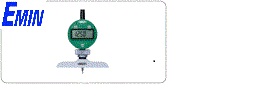
Where digital depth gauges are commonly used
These instruments are used wherever the depth of a feature needs to be verified without relying on estimation or manual scale reading. Typical tasks include checking blind hole depth, groove depth, shoulder height differences, countersinks, and internal steps on machined components.
They are also useful beyond precision machining. For example, the TOPTUL JEBM0125 Digital Tire Tread Depth Gauge is designed for tire tread measurement, showing how this category supports both industrial metrology and maintenance-oriented inspection work.
Why many users choose a digital format
The biggest advantage of a digital design is fast and readable measurement. An LCD display makes values easier to read than a traditional vernier scale, especially in production environments where operators need quick checks and less interpretation. Many models also support mm/inch conversion, which is useful for teams working with mixed drawing standards.
Another benefit is consistent repeat measurement. Instruments in this category may offer fine resolution for detailed inspection, while electronic functions such as auto power-off, zero setting, and clear numerical display help simplify day-to-day operation. If your process requires a non-electronic alternative, you may also want to review mechanical depth gauge options for simpler environments or users who prefer purely manual tools.
Common product types in this category
Digital depth measurement tools are not all built the same, and the right format depends on the feature being checked. Some models are closer to a digital depth caliper, using a wide base and sliding beam to measure recesses and slots over a practical measuring range. Others are digital depth micrometers, intended for finer measurement control and higher resolution in inspection tasks.
For example, the MOORE & WRIGHT range in this category includes digital depth micrometers such as the MW305 series, with variants from 0-25 mm up to 0-300 mm and 0.001 mm resolution. There are also digital depth calipers like the MW170 series, which are suitable for broader general-purpose depth checks where 0.01 mm resolution is appropriate.
Examples from leading manufacturers
This category features established metrology brands such as MITUTOYO and MOORE & WRIGHT, along with other recognized names in industrial measurement. These brands are often selected by buyers who need dependable instruments for workshop inspection, quality control, or maintenance routines.
A representative example is the MITUTOYO 571-265-20 electronic depth measuring caliper, which combines digital readout, inch/metric switching, and an IP67 waterproof design. On the other hand, MOORE & WRIGHT offers a broader spread of digital depth micrometers and depth calipers, making it easier to choose by range, base size, and required resolution rather than by brand alone.
How to choose the right digital depth gauge
Start with the measuring range. The instrument should comfortably exceed the maximum depth you need to inspect. For small and shallow features, a compact model may be enough, while deeper slots or cavities may require a 150 mm, 200 mm, or even 300 mm range.
Next, consider resolution and expected accuracy. A model with 0.01 mm resolution is often suitable for general workshop measurement, while 0.001 mm instruments are more appropriate when tighter control is needed. Base size also matters because a stable base improves alignment on the reference surface and helps reduce user-induced error during measurement.
Environmental conditions should not be overlooked. If the tool will be used near coolant, splashing water, or oily machine areas, a more protected instrument can be a practical choice. Users comparing broader brand options for measuring tools may also find it useful to browse the Mahr range for related metrology equipment.
Good measurement practice for reliable results
Even a quality digital instrument can produce poor readings if it is used carelessly. Before measuring, make sure the base surface and measuring rod are clean, and remove burrs, chips, oil, or dust from the workpiece. The gauge should sit flat on the reference face so that the measuring contact reaches the bottom of the feature without tilting.
Users should also confirm the zero setting before starting a measurement series. Avoid measuring moving parts, and do not force the instrument into narrow spaces that do not match its measuring geometry. After use, wipe the tool clean, store it in a dry place, and protect the display and beam from impact during transport or storage.
Matching the tool to the application
For general machining and inspection, a digital depth caliper is often a practical choice because it combines ease of use with adequate resolution for common dimensional checks. Where finer increments are required, a digital depth micrometer may provide better control, especially in inspection rooms or precision manufacturing environments.
Special applications should be matched to specialized tools. Tire tread measurement, for instance, calls for a compact design suited to that profile rather than a larger workshop depth caliper. Choosing the right instrument type helps improve repeatability, saves operator time, and supports more dependable inspection records.
FAQ
What is the difference between a digital depth caliper and a digital depth micrometer?
A digital depth caliper is generally more versatile for everyday depth checks, while a digital depth micrometer is typically chosen for finer resolution and more controlled precision work.
Is mm/inch conversion useful in industrial measurement?
Yes. It is especially helpful when suppliers, drawings, or customer specifications use different unit systems.
How do I know which measuring range to choose?
Select a range larger than the deepest feature you need to measure, while keeping the instrument practical for the size of the parts you inspect most often.
Choosing a suitable digital depth gauge is mainly about matching range, resolution, instrument type, and working environment to the real inspection task. A well-selected tool makes depth measurement faster to perform, easier to read, and more consistent across operators, whether the job involves machine parts, maintenance checks, or application-specific measurement.
-
-
-
-
-
-
-
-
-
-
-
-
-
-
-
-
-
-
-
-
-
-
-
-