


Indoor Air Quality Meter
Maintaining healthy and stable indoor conditions is increasingly important in offices, laboratories, clean rooms, schools, production areas, and public facilities. When ventilation, filtration, occupancy, and process conditions all affect air quality, a reliable Indoor Air Quality Meter helps users monitor the parameters that matter instead of relying on assumptions.
On this page, you can explore instruments designed to measure key air-quality indicators such as CO2, particulate matter, temperature, humidity, and in some cases barometric pressure. Depending on the application, these devices may be used for spot checks, long-term room monitoring, wall-mounted indication, or integration into broader building and environmental control systems.
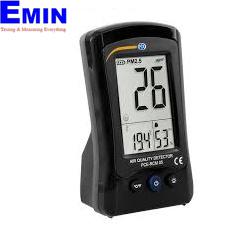
What an indoor air quality meter is used for
Indoor air quality measurement is not limited to comfort. In many technical environments, it supports ventilation assessment, process stability, worker wellbeing, and basic compliance monitoring. Elevated CO2 can indicate insufficient fresh air exchange, while abnormal humidity or temperature may affect storage conditions, electronics, materials, and occupant comfort.
Some applications also require visibility into airborne particles. For that reason, users sometimes compare this category with a dust monitor or a more specialized particle instrument. The right choice depends on whether the main priority is general indoor environment tracking or detailed particulate analysis.
Common parameters measured in this category
Many instruments in this range combine several readings in one device. Typical parameters include CO2 concentration, ambient temperature, and relative humidity, which together provide a practical overview of indoor conditions. Some models also calculate derived values such as dew point or wet-bulb temperature, helping users interpret moisture-related behavior more effectively.
Other devices extend measurement capability to PM2.5 or barometric pressure. For example, the TENMARS TM-280 Indoor Air Quality Monitor measures particulate matter together with temperature and humidity, making it suitable for quick checks in occupied rooms. The PCE AQD 20-ICA Environmental Meter goes further by combining PM, CO2, humidity, temperature, and air pressure in one platform, which is useful when multiple environmental variables need to be logged and reviewed together.
Portable, desktop, wall-mounted, and transmitter-based options
This category includes more than one device format, and the physical installation method often matters as much as the measured parameter list. Portable meters are useful for maintenance teams, facility inspections, troubleshooting complaints, and moving between rooms. Desktop or wall-mounted units, on the other hand, are often chosen for continuous local indication in classrooms, offices, meeting rooms, or controlled indoor spaces.
DaiHan offers several examples for room monitoring needs. The DH.GAS9 “Green Life” Indoor Air Monitor focuses on CO2, temperature, and humidity with time display, while the DH.GAS15 Wallmount Desktop Air Quality Monitor adds broader environmental values such as dew point and wet-bulb. For field use, the DH.GAS13 Air Quality Meter provides a handheld approach for checking indoor conditions at different locations without a fixed installation.
In more technical environments, a transmitter-style device may be more appropriate than a handheld meter. The Senseca ETS68 series is an example of a solution intended for continuous measurement of temperature, relative humidity, and barometric pressure, with RS485 output and, depending on model, analog signal options. This type of device fits building monitoring, clean room support, and integration with automation systems rather than basic spot-check use.
How to choose the right device for your application
The first step is to identify which variable is actually driving the problem. If you need to assess ventilation performance in occupied rooms, CO2 is often the starting point. If the concern is airborne fine dust, PM2.5 or particulate measurement becomes more relevant. If materials, storage, or process repeatability are involved, temperature and humidity stability may be just as important as gas concentration.
The next consideration is how the data will be used. A simple local display may be enough for room awareness, but service teams and technical users may need logging, alarm output, or communication interfaces. Models such as the PCE AQD 20-ICA support broader environmental review, while transmitter-type devices are more suitable where readings must be shared with a supervisory system.
It is also worth deciding whether you need a general IAQ instrument or a dedicated particle solution. If your work involves cleaner production spaces or more detailed contamination tracking, you may also want to review an air particle counter or a broader particle counter category.
Examples of instruments available in this category
Several products on this page illustrate the range of measurement approaches available. The TENMARS TM-280 is oriented toward indoor particulate, temperature, and humidity checks in a compact format. The Senseca HD37AB1347 Indoor air quality monitor is a portable instrument platform intended for professional environmental measurement tasks, especially where robust construction and probe-based operation are important.
For multi-parameter room monitoring, DaiHan models provide practical combinations of CO2, temperature, humidity, and derived values. The DH.GAS15 is suitable when a wallmount or desktop arrangement is preferred, while the DH.GAS13 supports portable surveys. The PCE AQD 20-ICA Environmental Meter is relevant for users who need a wider environmental picture, including CO2, PM2.5, humidity, temperature, and pressure, along with data storage capability.
Brand preference may also influence selection, especially for users standardizing procurement across projects. In this category, recognized options include PCE, DaiHan, Senseca, and TENMARS, each representing different use cases from portable measurement to installed monitoring and integrated environmental sensing.
Where indoor air quality meters are commonly applied
These instruments are used across many indoor environments where air conditions affect people, products, or processes. Typical examples include offices, meeting rooms, schools, healthcare areas, laboratories, warehouses, archives, and light industrial spaces. In such settings, the goal may be to confirm adequate ventilation, investigate comfort complaints, monitor environmental trends, or support preventive maintenance.
More controlled areas may require tighter oversight. Clean rooms and technical spaces often need stable humidity, temperature, and pressure behavior, which is why transmitter-based instruments are common there. Where the focus shifts toward contamination control and airborne particle counting rather than general room conditions, users may need to move from this category into more specialized particle monitoring equipment.
Key selection points before ordering
- Choose the parameters you actually need: CO2, PM2.5, temperature, humidity, pressure, or derived values such as dew point.
- Decide between portable inspection, desktop display, wall-mounted monitoring, or fixed transmitter installation.
- Check whether logging, alarms, RS485 communication, or analog output is necessary for your workflow.
- Match the device to the environment, especially if the application involves clean rooms, technical facilities, or continuous monitoring.
- Consider whether a general indoor air quality meter is sufficient or whether a dedicated particulate instrument would be more suitable.
Final considerations
Choosing the right indoor air quality instrument starts with understanding the measurement objective, not just the product format. A handheld meter may be ideal for quick surveys, while a wall-mounted monitor or transmitter is often better for ongoing observation and system integration. The models in this category cover a practical range of indoor monitoring needs, from basic room awareness to more technical environmental control.
If you are comparing devices for ventilation checks, comfort evaluation, or multi-parameter environmental monitoring, this category provides a strong starting point. Review the measured parameters, installation style, and data interface options carefully so the selected meter fits both the space and the way your team works.
-
-
-
-
-
-
-
-
-
-
-
-
-
-
-
-
-
-
-
-
-
-
-
-