


Frequency Online Controller
Stable frequency measurement is essential in many control panels, test benches, rotating equipment systems, and industrial automation lines. When a process depends on pulse, speed, or signal frequency, selecting the right Frequency Online Controller helps convert raw frequency signals into values that can be displayed, retransmitted, isolated, or used for alarm and control functions.
This category brings together devices designed for continuous frequency monitoring in real operating conditions. It is especially relevant for engineers who need reliable signal handling between field instruments, PLCs, indicators, and control systems, while maintaining accuracy, response stability, and practical integration into panel-based applications.
Where frequency online controllers are used
Frequency-based signals appear in a wide range of industrial environments. They are commonly associated with rotating machinery, pulse outputs from sensors, speed-related measurements, and electronic test signals that need to be monitored continuously rather than checked only during commissioning.
In practice, these devices can support signal conversion, display, retransmission, and isolation in control cabinets. They are often used where operators or automation systems need a stable frequency reading, a converted analog output, or a programmable signal interface for downstream equipment. In broader monitoring systems, they may also work alongside devices such as vibration monitoring equipment when machine condition and rotational behavior are both important.
What this category typically covers
The products in this range are not limited to simple display meters. A frequency online control solution may include frequency transmitters, DC-to-frequency converters, isolators and scalers, and panel meters for local indication. Each type serves a different role in signal conditioning and process integration.
For example, some models are built to receive a frequency input and convert it into common analog outputs such as voltage or current. Others take analog input signals and generate frequency outputs for systems that communicate or control by pulse rate. There are also models intended to isolate and scale signals, helping protect system integrity while improving compatibility between instruments.
Representative Adtek solutions in this category
This category includes solutions from Adtek, a manufacturer represented here with several frequency-related devices for panel and control applications. Instead of focusing on one form factor alone, the available range illustrates different signal paths that engineers may need in real projects.
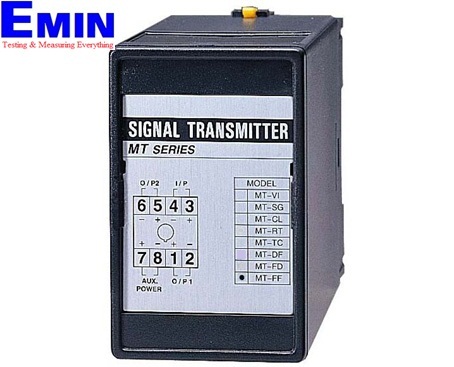
Examples include the ADTEK MT-FD1 and ADTEK MT-FD2 for frequency-to-analog transmission, the ADTEK MT-DF1 and MT-DF2 for DC-to-frequency conversion, and the ADTEK MT-FF1 and MT-FF2 for isolation and scaling. For local display and indication, models such as the Adtek CS1-F FREQUENCY Meter and Adtek CSF-400 provide options for panel-based monitoring. Across these examples, common selection themes include input range, output format, accuracy, and whether single or dual output is required.
How to choose the right frequency controller
The first point to confirm is the signal direction. Some applications require converting a field frequency signal into 0~20 mA or voltage for a PLC or recorder, while others need to generate a frequency output from an analog process signal. Choosing the wrong signal path can create integration problems even when the device appears electrically compatible.
Input range is equally important. Within this category, representative products cover frequencies from very low ranges up to tens of kilohertz, with some examples extending to higher optional ranges. If the process includes both slow pulse signals and higher-speed outputs, it is worth checking whether auto-ranging, ultra-low frequency support, or higher frequency options are necessary.
Output requirements also matter. Some projects only need a single retransmission path, while others benefit from dual output for simultaneous connection to display, logging, and control devices. In more advanced installations, relay contact, analogue retransmission, or communication capability can also influence the choice, especially where alarms or integration with supervisory systems are needed.
Why isolation and scaling can matter in control panels
In industrial wiring, signal quality is not always ideal. Noise, grounding differences, and mixed device standards can affect measurement stability. This is where isolator and scaler models become useful. Rather than simply passing a signal through, they help maintain usable signal integrity between the field side and the receiving side.
Products such as the ADTEK MT-FF1 and MT-FF2 illustrate this role well. They are relevant when a system needs frequency signal conditioning before being sent to another controller, recorder, or display device. In a larger panel design, this can reduce troubleshooting time and improve consistency across interconnected measurement loops, including systems that may also use a multi-function controller for centralized process handling.
Panel indication, alarms, and retransmission needs
Not every application needs a converter alone. In many plants, operators still need clear front-panel indication of frequency values for setup, inspection, and routine operation. A frequency meter can therefore play an important role even in automated lines, especially when local visibility is required at the cabinet level.
The Adtek CS1-F FREQUENCY Meter, for example, represents the type of solution suited to applications where measurement, display, and optional relay, analogue output, or communication functions may be combined. The Adtek CSF-400 is closer to a straightforward digital panel frequency meter. These options are useful where the requirement is not only signal conversion but also direct reading and basic control response in the field.
Integration considerations for industrial automation
When selecting equipment in this category, engineers usually evaluate more than just the measured variable. Power supply compatibility, response time, panel space, and output matching with PLC or DCS inputs all affect commissioning and long-term operation. Even a highly accurate device should still fit the practical constraints of the cabinet and the existing control architecture.
It is also helpful to consider the surrounding system. Frequency monitoring may be one part of a broader machine or process control strategy that includes load, power, or condition variables. Depending on the application, related product groups such as load cell online controllers or power controllers may be relevant when building a more complete measurement and control solution.
Finding the right fit for your application
A good frequency control setup starts with a clear understanding of the incoming signal, the required output, and the role the device must play in the system. Some users need a compact meter for local indication, while others need a transmitter, isolator, or converter that can bridge different signal standards with dependable performance.
Within this category, the available Adtek models show several practical paths for frequency monitoring, conversion, and panel integration. If you are comparing options for machine monitoring, pulse-based measurement, or process signal interfacing, reviewing the input type, frequency range, output format, and control features will help narrow the selection to the most suitable device.
-
-
-
-
-
-
-
-
-
-
-
-
-
-
-
-
-
-
-
-
-
-
-
-