


Belt tension gauge
Incorrect belt tension can shorten belt life, increase bearing load, create noise, and lead to unstable power transmission. In maintenance, installation, and machine servicing, having a reliable belt tension gauge helps technicians move from guesswork to repeatable measurement, especially on belt-driven systems where tension directly affects performance and component wear.
This category brings together instruments used to check belt vibration frequency, strand force, or mechanical tension on a wide range of drive systems. It is relevant for industrial maintenance teams, service contractors, OEM assembly, and workshops that need a practical way to verify belt condition during installation or periodic inspection.
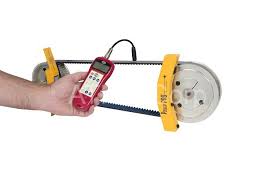
Where belt tension gauges are used
Belt tension measurement is common in motors, pumps, compressors, fans, conveyors, automotive service tasks, and other rotating equipment that depends on proper belt drive alignment and loading. A gauge helps confirm whether a newly installed belt is within the recommended range and whether an existing system has drifted due to wear, stretch, or operating conditions.
In many plants, belt tension checks are part of a broader reliability workflow alongside vibration, force, and deformation monitoring. For applications that extend into structural load or signal conversion, related tools such as strain meters or load cell transmitters may also be relevant depending on how the measured data is used.
Main measuring principles in this category
Most products in this category are designed around either frequency-based measurement or direct force-style mechanical checking. Frequency-based instruments detect the natural vibration of the belt span after it is excited, then calculate or display the result in hertz and, in some cases, convert that value into force units when belt data is entered.
Examples include the PCE PCE-BTM 2000A and PCE-BTM 2000L, the Checkline BTM-400PLUS, the SCHMIDT RTM-400, the SKF PHL FM10/400, and the CONTITECH VSM-3. These are well suited to users who want digital readings, repeatability, and support for maintenance documentation. By contrast, the Optibelt OPTIKRIK Tension tester represents a more mechanical approach that can still be useful for straightforward field checks.
How to choose the right belt tension gauge
The first selection factor is the measurement range. Different instruments in this category operate across different ranges, from lower-frequency vibration measurement up to broader frequency bands, or in force ranges expressed in pounds or newtons. Choosing a range that fits the belts and span lengths you actually work with is more important than simply selecting the widest available specification.
Next, consider the measurement method and working environment. A compact optical model such as the CONTITECH VSM-3 may suit routine portable checks, while devices such as the PCE-BTM 2000A or Checkline BTM-400PLUS may be preferable when users need memory functions, multi-language menus, or more detailed input of belt parameters. If the application involves band materials rather than standard drive belts, products like the Tensitron BTX-250-1 or BTX-500-1 are better understood as specialized tension meters for that ecosystem.
Examples of instruments available
Several products in this category illustrate the range of use cases. The PCE-BTM 2000A and PCE-BTM 2000L support frequency-based measurement over a broad range and are suitable for users who need stored readings and portable operation. The longer-sensor version can be especially helpful when access around the belt is limited.
The Seiffert KX-1590 sonic belt tensioning meter offers a compact format with readings in hertz, pounds, or newtons, making it practical for technicians who work across different service conventions. The Checkline BTM-400PLUS and SCHMIDT RTM-400 are also designed for digital belt tension measurement and fit maintenance teams that want a dedicated handheld instrument for regular checks.
For users working with brand-specific belt service workflows, options from CONTITECH, SKF, and Optibelt provide familiar measurement approaches. The CONTITECH VSM-3 uses an optical sensor for frequency reading, while the Optibelt OPTIKRIK Tension tester supports direct checking across defined force ranges. The SKF PHL FM10/400 is another example of a belt frequency meter intended for controlled and repeatable measurement in service environments.
Digital vs mechanical belt tension measurement
A digital gauge is usually preferred when traceability, repeatability, and easier operator-to-operator consistency are important. Digital models can reduce interpretation errors, support stored values, and in some cases provide calibration-related documentation, as seen with the PCE-BTM 2000A-ICA version supplied with an ISO calibration certificate.
A mechanical tester can still be useful where the task is quick verification, training is already established, or the maintenance process is based on traditional field methods. The right choice depends on whether your team prioritizes documentation, portability, ease of use, or a simpler tool for occasional checks.
What to review before ordering
Before selecting a model, it is worth checking the belt type, free span length, expected tension range, available access around the drive, and preferred output unit. Some users need only a frequency reading, while others want conversion to force units or the ability to store repeated measurements across multiple machines.
Power supply, sensor arrangement, display readability, and portability also matter in day-to-day maintenance. In some workflows, a belt tension gauge may sit alongside support equipment and accessories from a broader measurement setup, including selected peripheral devices used to organize field measurement tasks more efficiently.
Suitable users and buying scenarios
This category is relevant for maintenance departments, MRO buyers, machine builders, automotive workshops, and field service teams. A single-site workshop may choose a simple handheld unit for occasional belt replacement, while a production facility may prefer a digital model with memory and broader input capability for routine preventive maintenance.
It is also useful when standardizing maintenance procedures across multiple technicians. A defined measurement tool helps reduce variation in belt installation quality and supports more consistent machine uptime over time.
Final considerations
A well-matched belt tension gauge helps improve maintenance accuracy and reduces the risk of premature belt or bearing problems caused by over- or under-tensioning. Whether the requirement is a digital frequency meter, a sonic handheld device, or a mechanical tension tester, the best choice depends on the belt system, measurement method, and the level of repeatability your process requires.
Use this category to compare suitable instruments from manufacturers such as PCE, CONTITECH, Optibelt, SKF, Checkline, SCHMIDT, Seiffert, and Tensitron, then narrow your selection based on range, sensing method, and practical service conditions.
-
-
-
-
-
-
-
-
-
-
-
-
-
-
-
-
-
-
-
-
-
-
-
-