


Fruit hardness tester
When fruit quality has to be checked consistently across harvesting, storage, transport, and incoming inspection, a reliable measurement method becomes more useful than a simple visual check. A Fruit hardness tester helps quantify firmness so growers, traders, laboratories, and quality-control teams can make more informed decisions about maturity, handling conditions, and product acceptance.
In practice, fruit firmness is closely related to ripeness, shelf life, and resistance to damage during logistics. That is why this category is relevant not only for agricultural research, but also for fruit farms, packing facilities, distributors, and educational institutions working with post-harvest evaluation.
Why fruit firmness measurement matters
Firmness is one of the key indicators used to assess fruit condition. A measurable value gives teams a more repeatable basis for comparing batches, monitoring ripening, and checking whether fruit is suitable for storage, transport, or immediate sale. This is especially useful when product quality must be evaluated by more than one operator or at multiple stages of the supply chain.
Compared with a subjective hand-feel assessment, a dedicated tester improves consistency and traceability. For operations that need broader hardness measurement solutions for metals or industrial materials, related categories such as handheld hardness meters serve a very different purpose, while fruit instruments are designed around agricultural firmness testing.
Typical applications of a fruit hardness tester
These instruments are commonly used to evaluate apples, pears, strawberries, grapes, and other fruits with different skin and flesh characteristics. The goal is not simply to assign a number, but to support practical decisions such as harvest timing, grading, storage planning, or transport readiness.
In research and education, the tester can also help compare varieties, cultivation methods, and post-harvest handling conditions. For fruit companies and farms, firmness data is often used alongside visual inspection, weight, and size measurements to build a more complete quality profile.
What to look for when selecting an instrument
The right choice depends on the type of fruit being tested, the force range required, and how the results will be used. Softer fruits and smaller specimens may require different probe sizes and testing approaches than larger or firmer fruits. Ease of reading, unit selection, and stable sensor performance are also important in routine use.
For users who need digital data capture, features such as a computer interface and peak hold can be valuable in documentation workflows. If the test process must be standardized further, accessories such as test stands may improve repeatability by helping control the measurement procedure.
Representative products in this category
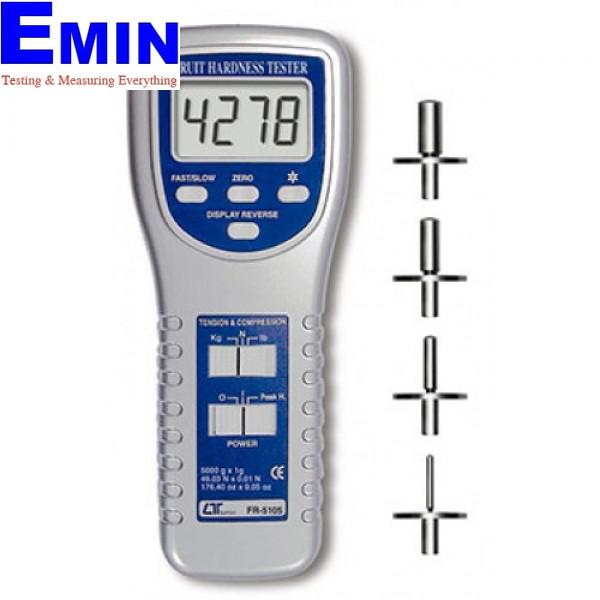
Among the featured options, the LUTRON range provides practical solutions for fruit firmness measurement. The LUTRON FR-5105 FRUIT HARDNESS TESTER is suitable for users who need a dedicated instrument for routine agricultural and quality-check applications.
Another notable model is the LUTRON FR-5120 FRUIT HARDNESS TESTER 20 Kg, which is intended for measuring fruit hardness across a range of common produce types. Based on the provided product information, it supports multiple units, uses a load cell sensor, and can work with different tip sizes, which helps adapt testing to varied fruit surfaces and firmness levels.
Understanding test setup and measurement consistency
A firmness reading is only useful when the test method is consistent. In everyday operation, that means paying attention to probe selection, test position, sample preparation, and the way force is applied. Even when the instrument itself is accurate, inconsistent technique can still affect the result.
For that reason, many users define a simple internal test routine, such as checking the same area of the fruit, using the same tip for the same fruit type, and recording measurements under similar conditions. In more formal quality systems, this type of standardization helps improve comparability across operators and batches.
How this category fits within a broader hardness testing workflow
Fruit firmness instruments belong to a specialized part of the hardness testing landscape. Their role is very different from systems used for metals, industrial components, or laboratory material evaluation. If your work also involves calibration or verification of other hardness instruments, categories such as standard blocks for hardness testers may be relevant in a separate industrial context.
Likewise, users comparing fixed and portable methods for engineering materials may also review solutions like the Rockwell hardness tester. For fruit and post-harvest applications, however, the priority is usually controlled penetration-based firmness evaluation rather than metal hardness scales.
Choosing based on your working environment
If the tester will be used in the field, portability and simple operation may be more important than advanced connectivity. In a lab or quality-control room, a digital display, data output, and accessory compatibility may carry more weight. The expected testing frequency also matters, especially when multiple fruit varieties are handled throughout the day.
It is often helpful to start with the fruit types you test most often, then match the instrument to your required range, probes, and reporting needs. A well-matched device supports faster inspection, clearer decision-making, and more reliable quality records over time.
Conclusion
A fruit hardness tester is a practical tool for turning firmness assessment into measurable, repeatable data. Whether the goal is to check ripeness, support harvest decisions, monitor storage suitability, or improve quality control, selecting the right instrument depends on application fit rather than broad claims. Reviewing intended fruit types, testing conditions, and workflow requirements will help narrow the most suitable option in this category.
-
-
-
-
-
-
-
-
-
-
-
-
-
-
-
-
-
-
-
-
-
-
-
-