


C-Type Temperature Sensor
Accurate temperature measurement in very high-temperature processes depends on more than the sensing element alone. Cable selection, insulation stability, mechanical protection, and compatibility with the sensor type all affect signal quality and long-term reliability. For applications built around C-Type Temperature Sensor assemblies, choosing the right extension wire and related components is an important part of a dependable measurement loop.
This category is focused on solutions used with Type C thermocouple systems, especially where tungsten-rhenium conductors are selected for demanding thermal environments. These products are typically considered in research furnaces, thermal processing, materials testing, and other applications where users need a thermocouple family suited to elevated temperatures and stable signal transmission from the sensing point to the instrumentation.
Where C-type temperature sensing is typically used
Type C thermocouple systems are commonly associated with high-temperature measurement tasks that go beyond the range of more general-purpose thermocouple types. In practice, they are often specified when users need tungsten-rhenium thermoelements and want to maintain compatibility across the probe, extension cable, and connection points.
On a category page like this, that usually means the focus is not only the sensor itself, but also the supporting wiring used to carry the thermoelectric signal with minimal mismatch. If your application uses another thermocouple family, it may be more appropriate to compare with G-Type temperature sensor options or review D-Type temperature sensor products for similar high-temperature measurement requirements.
Why extension wire matters in a thermocouple system
A thermocouple circuit is sensitive to material pairing and connection integrity. Using the correct thermocouple extension wire helps preserve the expected voltage relationship generated by the sensor, which is critical for accurate readings between the sensing point and the receiving instrument.
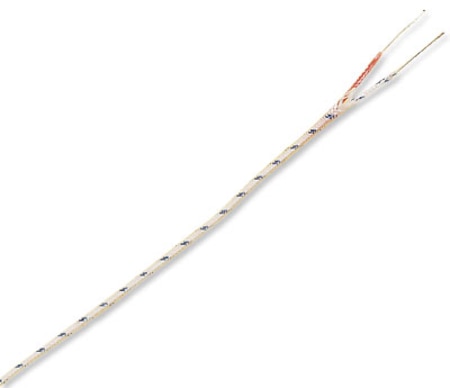
Within this category, the featured products include duplex extension wire designed for Type C applications. These cables are intended to work with thermocouple-based sensing systems rather than serving as standalone sensors. That distinction matters in industrial purchasing, because the wire must be selected to match the thermocouple type, insulation requirement, routing conditions, and installation length.
Representative product configurations in this range
The listed range highlights several OMEGA extension wire variants for Type C thermocouple systems, available in practical lengths such as 50 ft, 100 ft, 200 ft, 500 ft, 1000 ft, and metric alternatives like 7.5 m. Examples include OMEGA EXGG-C-24-SB-50, EXGG-C-24-SB-100, EXGG-C-24-SB-500, EXGG-C-24-SB-1000, and EXXT-C-24-7.5M. These products show how the category supports both shorter machine-level wiring runs and longer routing distances in lab or industrial layouts.
Construction details also vary depending on the installation environment. Some models use fiberglass insulation with stainless steel or tinned copper overbraiding for added mechanical protection, while others use PFA or Nextel® 312 constructions where the cable build needs to align with heat exposure, abrasion risk, or routing constraints. For buyers standardizing on one supplier, the OMEGA product range is a relevant reference point within this category.
Key selection factors before ordering
The first step is confirming compatibility with the thermocouple type in use. For C-type systems, the conductor materials and color coding should match the intended sensor and instrumentation scheme. In the products shown here, ANSI color coding and tungsten-rhenium conductor pairing are central characteristics, helping users identify suitable wire for Type C measurement circuits.
The second step is reviewing cable construction. Pay attention to wire gauge, insulation material, braid or overbraid type, and required run length. A 24 AWG solid conductor may be appropriate for many fixed installations, but the surrounding environment often determines whether fiberglass, PFA, or braided high-temperature insulation is the better fit. Stainless steel overbraiding may be preferred where additional mechanical robustness is needed, while tinned copper overbraiding can be useful in other routing conditions.
The third step is considering the full installation path. Routing near hot surfaces, through panels, across moving equipment, or into protective conduit can affect which cable style is practical. If the application also involves vessel or process hardware, related mounting solutions such as pipe and tank mounting components may help complete the measurement assembly.
Understanding insulation and braid options
Insulation material is not a minor detail in thermocouple wiring. Fiberglass constructions are often selected where elevated ambient temperatures are expected and flexibility in industrial layouts is required. PFA-insulated versions may be considered where chemical resistance or different handling characteristics are important, while Nextel® 312-based constructions support applications that call for specialized high-temperature cable materials.
The outer braid also affects how the cable performs in service. Stainless steel overbraid can add durability against wear and handling, especially in harsher plant environments. Tinned copper overbraiding may be used in configurations where shielding or mechanical reinforcement is desirable without the same emphasis on metallic armor characteristics. Selection should be based on the physical installation, not only on nominal temperature range.
How this category fits into a broader temperature measurement setup
In many projects, the sensor, extension wire, connectors, and mounting hardware are sourced together to reduce compatibility issues during commissioning. A Type C measurement point may start with the probe itself, but field performance often depends on whether the extension cable remains matched and properly terminated throughout the run.
That is why this category is useful not only for replacing existing cable but also for planning new systems. Users comparing multiple thermocouple families or specialized sensor formats may also want to review other temperature sensor categories when the process conditions or instrument interface are still being defined.
Choosing the right product for your application
If your priority is a compact run inside equipment, a shorter length such as 50 ft or 100 ft may be sufficient and easier to manage during installation. For larger furnace layouts, test rigs, or routing back to remote panels, longer versions such as 500 ft or 1000 ft can simplify procurement and avoid unnecessary splices.
It also helps to compare the practical differences between models rather than looking only at part numbers. For example, the OMEGA EXGG-C-24-TCB-1000 and EXGG-C-24-TCB-200 illustrate Type C duplex extension wire in longer and shorter lengths with fiberglass insulation and tinned copper overbraiding, while products such as EXTT-C-24-SB-100 or EXXT-C-24-SB-50 reflect different insulation constructions for applications with distinct mechanical or environmental needs.
Final considerations
When specifying components for a high-temperature thermocouple circuit, consistency across the sensing chain is essential. This category brings together products relevant to C-type temperature measurement, with an emphasis on extension wire options that support signal continuity, installation reliability, and compatibility with Type C thermocouple systems.
Before ordering, verify the thermocouple type, required cable length, insulation style, braid construction, and installation environment. A careful match between the sensor and its extension wiring will usually do more for measurement stability than simply choosing the longest or most heavily protected cable available.
-
-
-
-
-
-
-
-
-
-
-
-
-
-
-
-
-
-
-
-
-
-
-
-