


Metal detector in packaged products
Contamination control becomes more challenging once products are sealed, grouped, or moved at production speed. In these situations, reliable inspection equipment helps manufacturers identify unwanted metal fragments before goods leave the line, supporting quality control, traceability, and a more consistent final product.
Metal detector in packaged products solutions are typically selected for production environments where finished or semi-finished items must be screened after packing or during conveyor transfer. This category is relevant for factories that need practical detection coverage, stable throughput, and alarm handling that fits into everyday inspection workflows.
Where this category fits in industrial inspection
Packaged product inspection is usually part of a broader process focused on preventing foreign metal contamination from reaching downstream packing, warehousing, or shipment. Depending on the production setup, the detector may be installed after sealing, before carton packing, or at a transfer stage where product orientation and line speed are easier to control.
Compared with handheld search tools or construction-focused locating devices, these systems are intended for routine inline inspection. If your application is specifically related to garments, sewn goods, or similar soft materials, it may also be helpful to review metal detector solutions for textile products for a closer match to that workflow.
Common equipment formats in this category
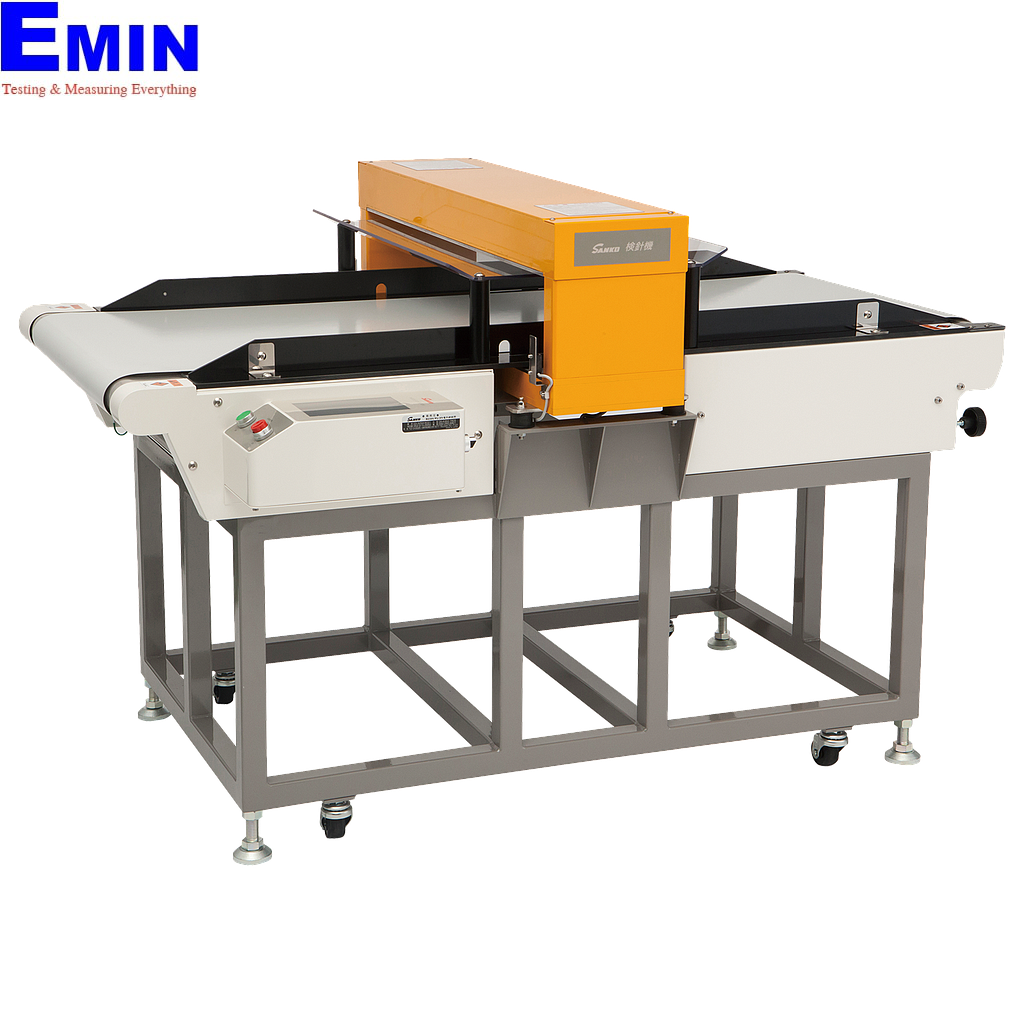
One of the main distinctions is between conveyor type detectors and smaller bench or portable inspection devices. Conveyor systems are often used when products move continuously and the inspection step needs to be integrated into the production line. These models typically combine a detection head, belt transport, and alarm or stop functions that help operators isolate suspect items quickly.
Smaller detectors are better suited to spot checking, manual inspection, or stations where operators scan limited product volumes. In practice, many factories use both formats together: an inline system for routine screening and a portable detector for secondary checks, verification, or re-inspection of questionable items.
Representative products from SANKO and MULTI
Within this category, SANKO is represented by several conveyor and tabletop-style needle and iron piece detectors designed for industrial use. Examples include the SC1-600 and SC1-600W, which use electromagnetic induction and are configured for 600 mm passing width, as well as the SC1-750 for wider product flow. For larger conveyor applications, models such as the APA-6800, APA-6800W, and APA-1500F illustrate how inspection systems can be adapted to different belt widths, head arrangements, and line layouts.
For smaller-scale inspection tasks, MULTI offers compact handheld and portable options such as the MDS-100V, TY-30, and TY-20Z. These devices are useful when operators need a simple way to inspect localized areas, check samples, or support quality control outside a fully automated line. The difference in form factor is important: a portable detector does not replace an inline conveyor system, but it can complement one effectively.
How detection method affects use case
The products in this category include systems based on electromagnetic induction, magnetic induction, and permanent magnetic induction. In practical terms, the detection method influences how the equipment responds to small ferrous contaminants, the inspection zone configuration, and the type of products that can be screened efficiently within the intended process.
For buyers comparing models, it is usually more useful to think in terms of application conditions than theory alone. Passing width, product height, belt speed, and alarm behavior often matter just as much as nominal detection sensitivity. A detector that fits the physical package size and real conveyor conditions is generally easier to run consistently than a model chosen only for one headline detection figure.
Key selection points for packaged product inspection
When evaluating equipment, start with the dimensions and movement of the packaged product. The available passing width and height need to match the actual item or tray format, while the conveyor speed should be compatible with the required production rate. In the listed SANKO systems, for example, there are clear differences between compact 600 mm class models and wider systems built for larger product flows.
It is also important to review how the machine reacts when metal is detected. Alarm outputs such as buzzer and lamp indication are common, and some systems also stop the belt or reverse movement to make removal easier. These functions are not minor details; they directly affect operator response time, line interruption, and the ability to separate nonconforming product without confusion.
Another practical point is whether you need a single-head or twin-head configuration. Twin-head arrangements can be relevant when inspection geometry or product presentation calls for broader or more robust coverage, while single-head systems may be sufficient for simpler layouts and lower installation complexity.
Typical applications and operating considerations
Packaged product metal detection is relevant in production settings where contamination risks may come from broken needles, metal fragments, worn machine parts, or incidental contact with metallic objects during handling. These inspection steps are often used as part of final quality control, especially when the product has already moved through sewing, cutting, forming, or mechanical processing stages.
Stable operation depends not only on the detector itself but also on line conditions. Product spacing, guide design, package orientation, and the consistency of belt transport can all influence inspection reliability. Some conveyor models in this category include options such as guides, emergency stop switches, foot switches, or remote switches, which can help adapt the system to the actual production environment rather than a generic layout.
Related categories for other metal detection tasks
Not every metal detection requirement belongs in packaged goods inspection. If the job involves maintenance, utility tracing, or building-related detection, readers may find more suitable tools in the pipe and cable locator range or in metal and wires in walls detectors. These categories serve different technical purposes and should not be treated as substitutes for inline product inspection.
Separating these use cases at the selection stage helps avoid mismatch between equipment capability and the real task. Industrial packaged product inspection is fundamentally about controlled product flow and contamination screening, whereas maintenance and search detectors are designed for locating hidden objects in structures or underground environments.
Choosing a practical system for your line
The right solution depends on how products move, how large the packages are, and whether inspection is continuous or manual. A compact portable unit may be enough for spot checks or workstation verification, while conveyor-based equipment is more appropriate when the objective is consistent screening at production speed with automatic alarm response.
This category brings together inspection options suited to that packaged-product context, with examples from SANKO and MULTI covering both inline and portable approaches. By comparing detection method, machine format, inspection opening, and response behavior, buyers can narrow down the most appropriate equipment for their process with greater confidence.
-
-
-
-
-
-
-
-
-
-
-
-
-
-
-
-
-
-
-
-
-
-
-
-