


Industrial Humidity Sensors
Stable humidity measurement matters in far more places than climate control alone. From cabinets, racks, and control panels to process equipment, storage areas, and connected monitoring nodes, reliable sensing helps operators protect product quality, prevent condensation issues, and maintain consistent operating conditions. This is where Industrial Humidity Sensors become an important part of a broader environmental monitoring strategy.
On this page, buyers can compare industrial-grade options for fixed installation, embedded design, and networked monitoring. The range includes compact PCB-level sensing modules, wired field devices, and wireless sensor nodes that combine humidity and temperature data for industrial and infrastructure applications.
Where industrial humidity sensing is used
Humidity is a critical variable anywhere moisture can affect materials, electronics, process stability, or stored goods. Typical use cases include equipment enclosures, server and telecom racks, HVAC-related monitoring, industrial rooms, warehouse areas, and production zones where both temperature and relative humidity need to be tracked together.
In many projects, humidity data is not viewed in isolation. It is often part of a wider environmental sensing setup that may also include water-quality or process-related devices such as DO sensors or chlorine sensors, depending on the application environment. Choosing the right sensing technology depends on whether the priority is room monitoring, embedded measurement, rugged outdoor deployment, or integration into an industrial network.
Common sensor formats in this category
This category covers several form factors, and each one serves a different integration path. PCB-mounted humidity sensors are typically selected for OEM equipment, control boards, and compact electronic assemblies where low power consumption and digital interfacing are important. Products such as the Renesas Electronics HS3103-MC1 and HS3103-MC2 illustrate this type of compact module-oriented approach, with digital output and I2C communication suited to embedded designs.
There are also panel, rack, and field-installable devices intended for direct deployment in industrial environments. For example, the Tripp Lite ENVIROSENSE rack environment sensor fits monitoring tasks in rack-level infrastructure, while the Advantech 96PD-THS16B shows the value of an RS-485 based sensor for industrial communication and longer-distance integration in control systems.
A third group focuses on wireless humidity monitoring. Models such as the Banner Engineering DX80N9Q45THA NB and Advantech LEO-S552-THG0 are relevant when cabling is difficult, remote points need to be added quickly, or data must be collected across distributed assets. In these scenarios, wireless sensing can reduce installation complexity while still supporting temperature and humidity visibility.
What to consider when selecting an industrial humidity sensor
The first selection factor is the required measurement range and accuracy. Some applications only need general environmental trending, while others need tighter control for process protection, storage conditions, or electronics reliability. Relative humidity range, stated accuracy, and resolution all influence whether a device is suitable for indication, control, or higher-confidence monitoring.
The second factor is operating environment. Buyers should check temperature range, enclosure protection, and mounting method carefully. Sensors intended for clean indoor cabinets differ from those exposed to dust, washdown risk, or outdoor conditions. Devices with ratings such as IP65 or IP67 can be more appropriate where moisture ingress or harsh installation conditions are expected.
Finally, integration matters as much as sensing performance. Some systems require analog output, others digital interfaces like I2C, and many industrial control platforms benefit from RS-485 or wireless connectivity. Supply voltage, current consumption, and mechanical installation style should also match the host system from the start to avoid redesign later.
Examples of product types in this range
For embedded electronics, Renesas Electronics modules such as the HS3103-MC1 and HS3103-MC2 are representative of compact digital humidity sensing for board-level integration. These products are suitable when designers need a small footprint, low-power operation, and a straightforward interface into a controller or data acquisition platform. For similar embedded and component-level sourcing, it can also be useful to browse the broader Renesas Electronics portfolio.
For industrial nodes and remote monitoring, Advantech offers several examples within this category, including the ADAM-2031Z-AE temperature and humidity sensor node, the LEO-S552-THG0 LoRaWAN sensor, and the 96PD-THS16B with RS-485. Together, these illustrate different integration paths: wireless sensing for distributed sites, wired communication for industrial systems, and application-specific monitoring hardware for infrastructure environments.
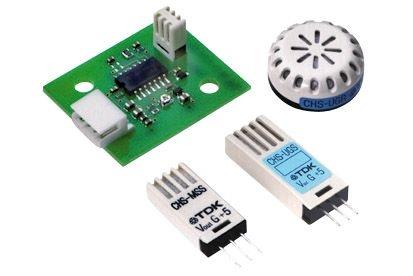
Other examples include the Banner Engineering DX80N9Q45THA NB for wireless deployment, TDK CHS-UPS for industrial humidity measurement in a defined operating range, and the Tripp Lite ENVIROSENSE rack sensor for IT and cabinet monitoring. TE CONNECTIVITY SENSORS devices in this category also reflect use cases where humidity sensing must fit into equipment-level or application-specific platforms.
Wired, digital, and wireless integration paths
In practical projects, the preferred sensor often depends on how data will be collected. A digital humidity sensor with I2C is commonly chosen for embedded controllers, compact data loggers, or custom boards. This route suits OEM development where designers manage the firmware and want direct access to measured values inside the electronics architecture.
Wired industrial communication is often preferred for building systems, automation panels, and long-term fixed installations. Interfaces such as RS-485 can simplify integration into supervisory systems and industrial networks where stability and structured field wiring are priorities. By contrast, wireless nodes are useful for retrofit projects, temporary monitoring, remote locations, or spaces where running cable is costly or disruptive.
If the application extends beyond air humidity alone, adjacent sensing categories may also be relevant. In water treatment, environmental process monitoring can involve devices such as turbidity sensors or free ion sensors, depending on the broader measurement scope.
How to match the sensor to the environment
For indoor electronics, racks, and control cabinets, compact or rack-oriented sensors are usually the most practical choice. These applications often prioritize response to environmental changes, easy installation, and reliable trending of both temperature and humidity. Rack sensors and compact modules help identify hot spots, moisture buildup, and conditions that could affect sensitive equipment.
For factory floors, utility spaces, and industrial enclosures, buyers should pay closer attention to ruggedness, cable termination, communication interface, and operating temperature range. A sensor exposed to demanding thermal conditions or installed near washdown-prone equipment may need a more robust housing and ingress protection than a board-level component would provide.
For large or distributed facilities, wireless devices can make expansion easier. They are especially useful when adding monitoring points incrementally, covering remote assets, or sending environmental data into IoT and supervisory platforms without extensive rewiring.
Choosing with long-term reliability in mind
A good selection process starts with the actual operating condition, not just the headline specification. Buyers should consider where the sensor will be mounted, how often data needs to be updated, what control or monitoring system it must connect to, and whether the environment is stable, harsh, or difficult to access. This helps narrow the choice between module-level sensors, field devices, and wireless nodes.
This category brings together solutions for embedded design, industrial automation, rack monitoring, and remote environmental sensing. By comparing interface type, protection level, installation style, and measurement performance, engineering teams can choose a humidity sensor that fits both the physical environment and the system architecture with fewer compromises over time.
-
-
-
-
-
-
-
-
-
-
-
-
-
-
-
-
-
-
-
-
-
-
-
-